LOCUS-DT: Digital-Twin Posterior Localization
I lead LOCUS-DT, a wireless-localization framework that compares an observed multipath snapshot with candidate-specific signatures generated by a ray-tracing wireless digital twin. The learned compatibility scores form a posterior over transmitter location, including multiple plausible modes when the measurement is incomplete or the model is imperfect.
Observation-conditioned digital-twin inference
For every candidate location, the digital twin supplies the multipath structure that the receiver would expect. LOCUS-DT scores the agreement between those simulated hypotheses and the measured path peaks, then normalizes the scores into a calibrated spatial belief.
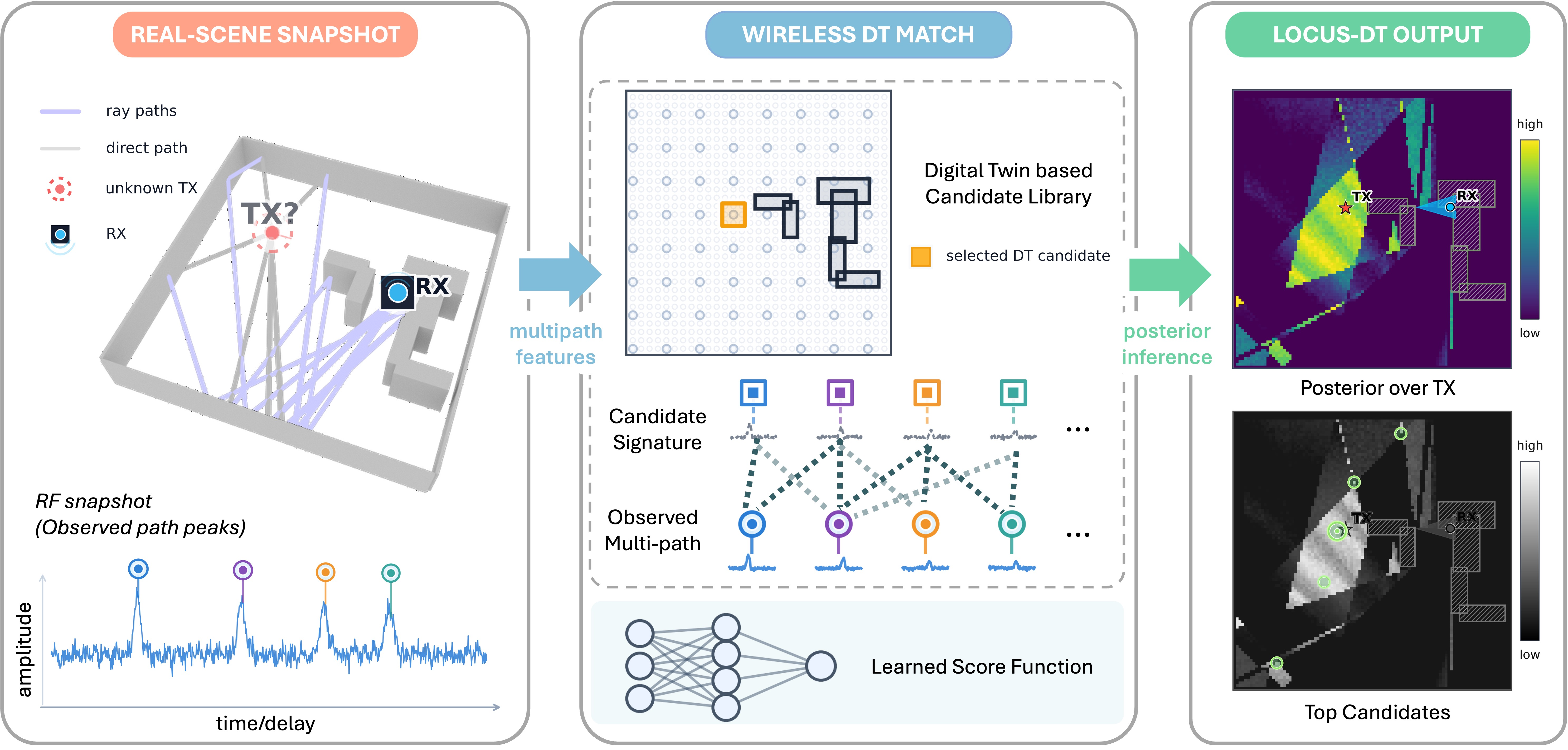
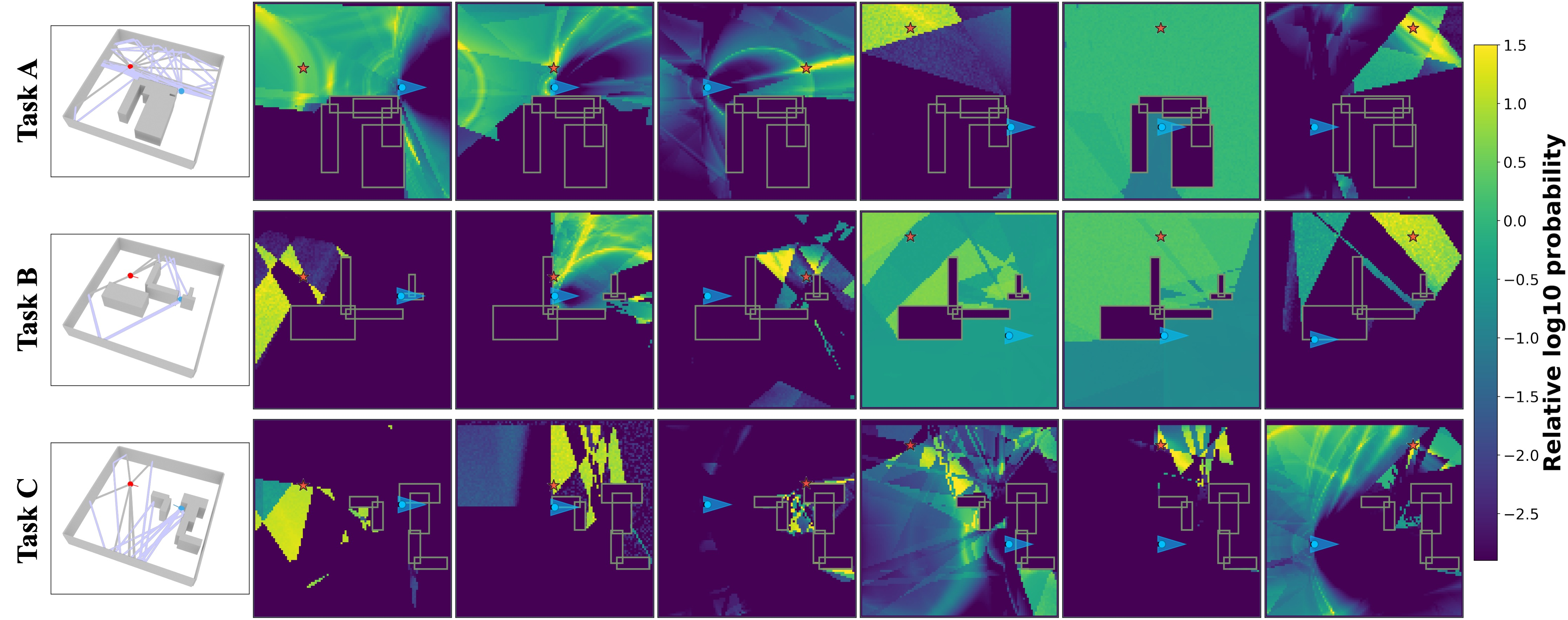
The peer-reviewed IEEE GLOBECOM 2026 paper establishes LOCUS-DT. The first- and corresponding-author journal extension, Site-Agnostic Posterior Inference for Indoor Localization with Ray-Tracing Wireless Digital Twins, studies site generalization and explicit digital-twin mismatch; a revision is in preparation for resubmission to IEEE Transactions on Wireless Communications (TWC).
Relationship to MC-CLE
LOCUS-DT and MC-CLE share a full-posterior localization objective but use complementary models. LOCUS-DT explicitly evaluates observed multipath against ray-traced candidate signatures; MC-CLE learns a measurement-conditioned candidate likelihood. Their common output is calibrated spatial belief that can support localization, multi-view fusion, and active sensing.