MC-CLE: Full-Posterior Wireless Localization
I lead MC-CLE, a probabilistic localization method that asks how compatible each candidate transmitter location is with a sparse angle-and-strength measurement. Instead of forcing ambiguous RF evidence into one coordinate, MC-CLE learns a spatial likelihood field that retains directional structure and multiple plausible hypotheses.
From physical measurement to spatial likelihood
The model conditions candidate-wise scoring on receiver geometry and the measured channel signature. Normalizing the scores over candidate locations yields a full posterior that can be calibrated and fused across measurements.
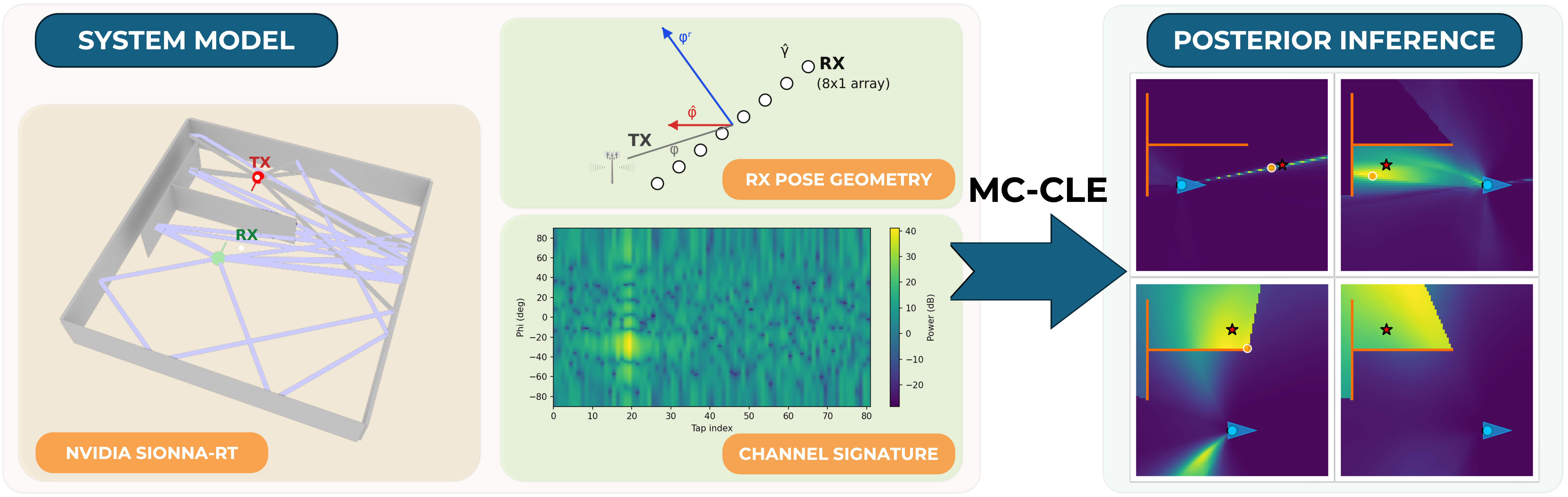
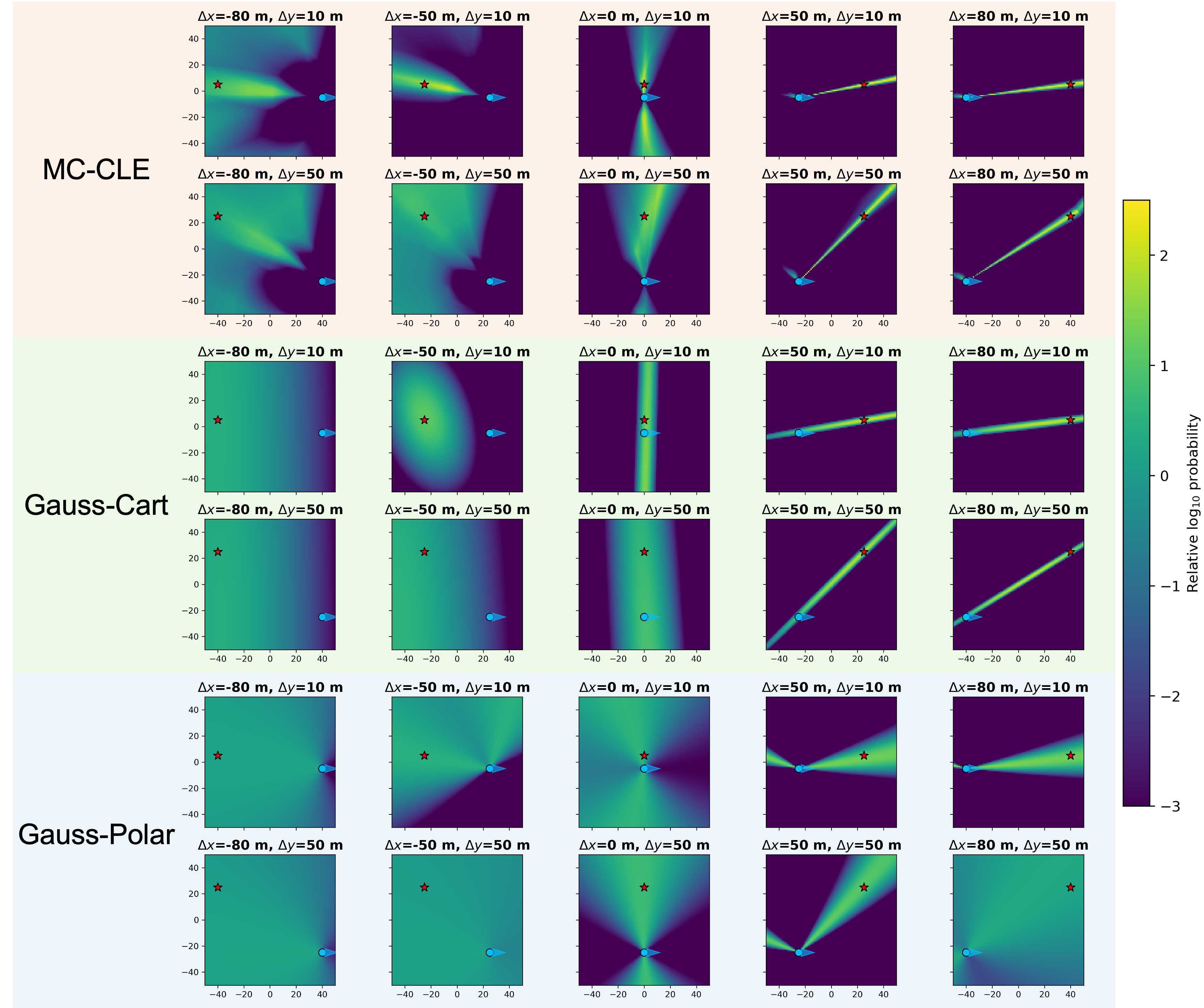
The peer-reviewed Asilomar 2026 paper introduces likelihood-based full-posterior localization. The first- and corresponding-author journal extension, Learning a Measurement-to-Posterior Map for Wireless Localization, is under review at IEEE Transactions on Vehicular Technology (TVT).
Relationship to LOCUS-DT
MC-CLE and LOCUS-DT address the same full-posterior localization objective through complementary model classes. MC-CLE learns a measurement-conditioned candidate likelihood, while LOCUS-DT explicitly compares observations with ray-traced candidate signatures. Both provide calibrated spatial belief as an interface to downstream localization and autonomous sensing.