Robotic RF Localization & Experimental Systems
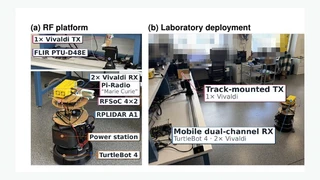
I lead the architecture and development of MobiFR3, a heterogeneous 10-GHz robotic RF testbed for localization experiments and SLAM-based navigation. The current system connects Pi-Radio SDR channel sounding with TurtleBot4/ROS 2, odometry, 2D LiDAR, and RGB sensing. Jackal UGV integration is in progress.
My role spans system architecture, experiment design, RF-robot synchronization, measurement-aligned simulation, localization inference, and evaluation. I mentor student collaborators in RF hardware operation, calibration, and data collection; routine RF acquisition is conducted as a team rather than presented as a single-person hardware effort.
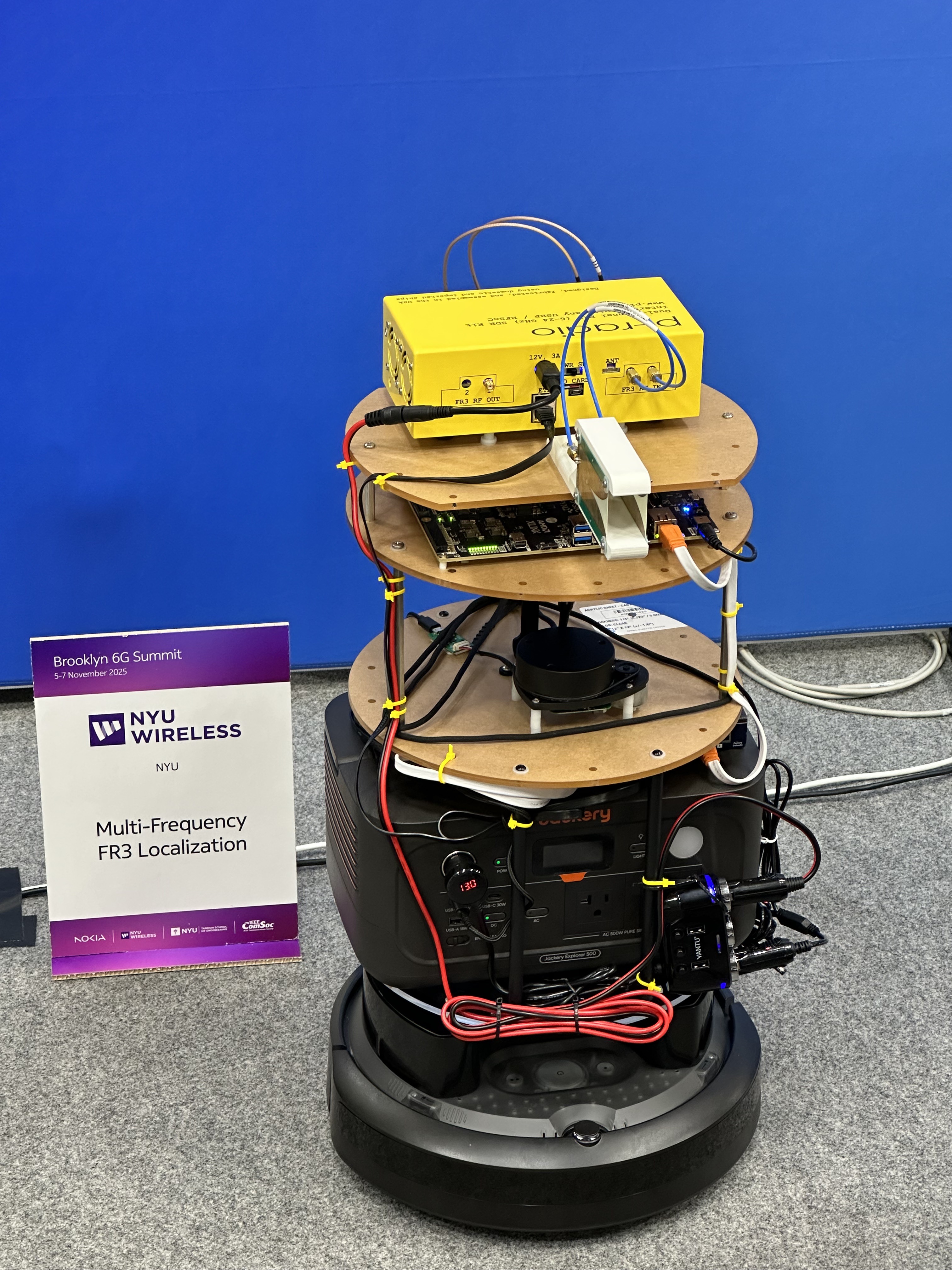
MobiFR3 integrates the mobile robot, RF front end, compute, power, and control layers into one experimental platform.
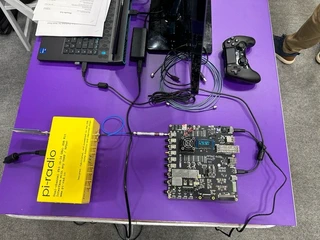
The team-operated Pi-Radio SDR stack combines FR3 RF hardware, Vivaldi antennas, and local compute/control equipment.
From system to inference
MobiFR3 provides the measured data and controlled geometry used by MAGNETAR. The algorithm learns a joint posterior over transmitter position and heading from asynchronous AoA/SNR multipath snapshots, with real-to-sim calibration based on measured antenna patterns and RF-chain/noise effects. This connects the physical system directly to probabilistic inference rather than treating the robot as a demonstration platform alone.
Media & Public Demonstrations
Interview recorded at the Brooklyn 6G Summit 2025.
At the 2025 Brooklyn 6G Summit, I demonstrated the FR3 robotic sensing and localization system, combining TurtleBot4 mobility, Pi-Radio hardware, angle-of-arrival measurements, and SLAM-based mapping. The demonstration showed how RF observations can support indoor positioning when visual information is incomplete or unavailable.
System capabilities
- Pi-Radio SDR channel sounding with Vivaldi antennas and motion-controlled 10-GHz measurements.
- Transmit/receive waveform control, capture, synchronization, channel estimation, SNR estimation, and AoA processing in a team-operated workflow.
- Scripted TurtleBot4, linear-track, and D48 pan-tilt motion for reproducible measurement grids.
- Measurement-aligned Sionna RT scenes with TX/RX pose and motion, measured antenna patterns, and stochastic RF-chain/noise effects.
- Physical validation for posterior localization and future closed-loop sensing/navigation experiments.