MAPLE-RF: Localization with Partial Maps
I lead MAPLE-RF, an efficient probabilistic RF source-localization method for environments that are still being mapped. The core problem is common in robotic search: a receiver knows its own pose, but most of the surrounding floor plan may remain unobserved, including obstacles that could block or reflect the signal.
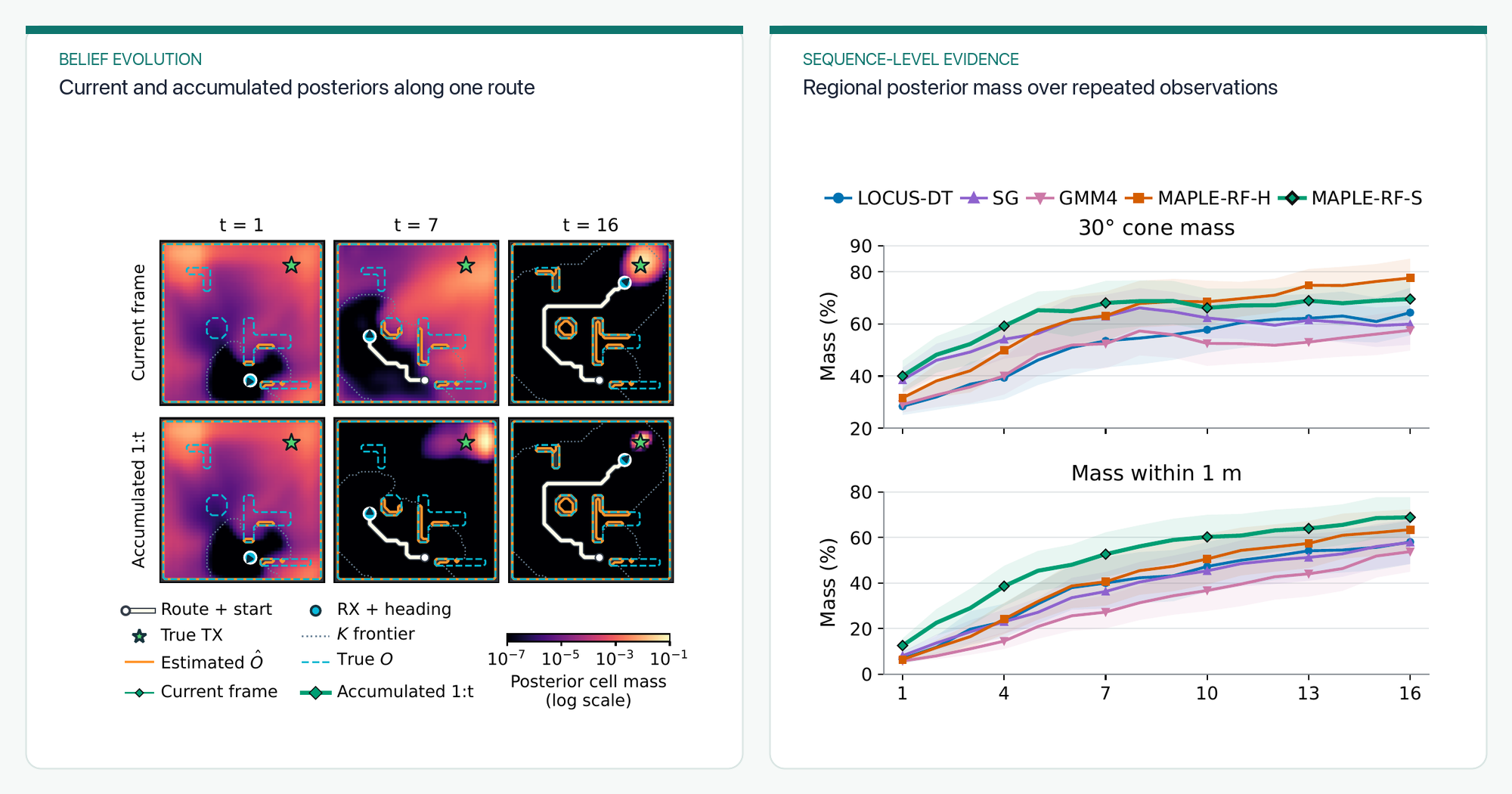
The simulation follows a receiver along a recorded route while the observed map grows and the transmitter posterior is updated.
Method
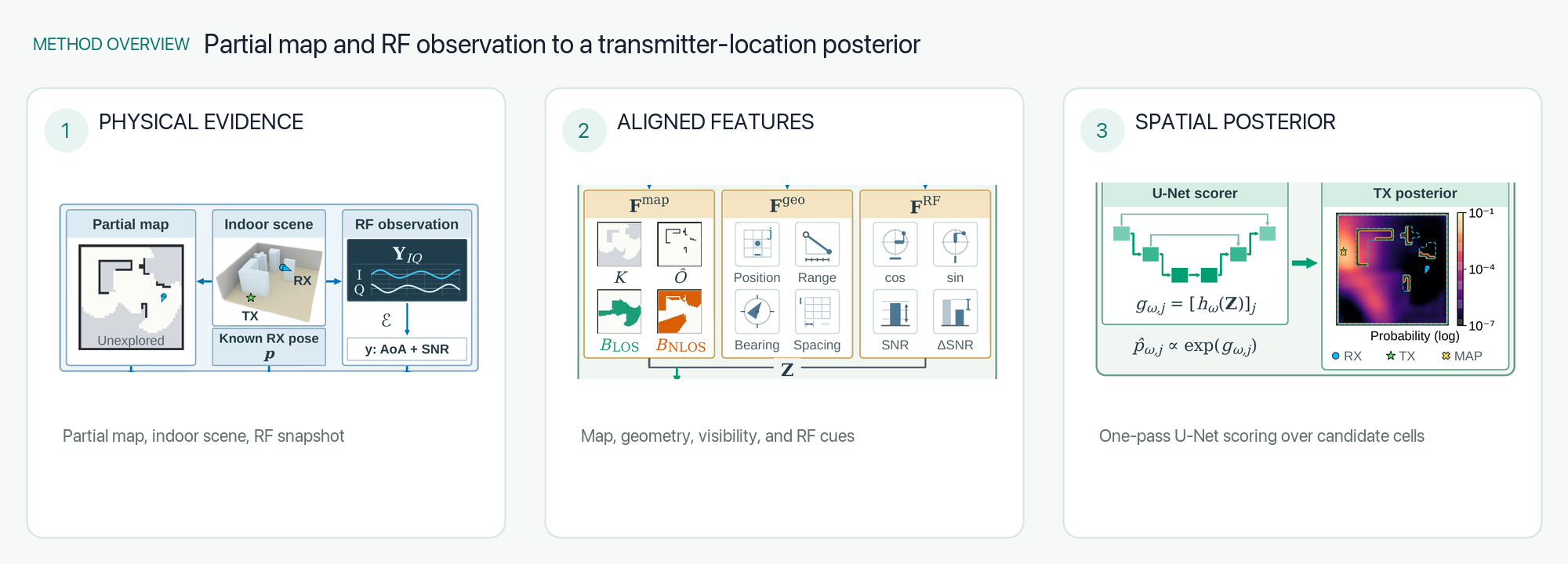
MAPLE-RF aligns estimated path angles and SNRs with spatial channels for map knownness, occupancy, line-of-sight visibility, receiver pose, bearing, and range. A residual U-Net then scores every candidate transmitter location in one pass. Unlike a full-grid digital-twin query, inference does not ray-trace every candidate whenever the map or receiver pose changes.
Findings
- Training across mixed levels of map coverage is essential for localization with unexplored space.
- MAPLE-RF retained about 94% of its complete-map 1-m recall when 75-85% of the map was unobserved.
- Fresh-query inference was about 218 times faster than full-grid general-purpose ray tracing in the evaluated configuration.
- Bayesian accumulation along exploration routes placed more posterior probability near the source than the compared baselines.
The current study is simulation-based. Its role in the broader research program is to make posterior RF localization practical when a robot must localize and map concurrently, before a complete digital twin is available.
Paper: MAPLE-RF: Efficient Probabilistic RF Source Localization in Partially Explored Environments — first and corresponding author; IEEE ICRA 2027, under review.