MAGNETAR: Joint RF Pose Inference
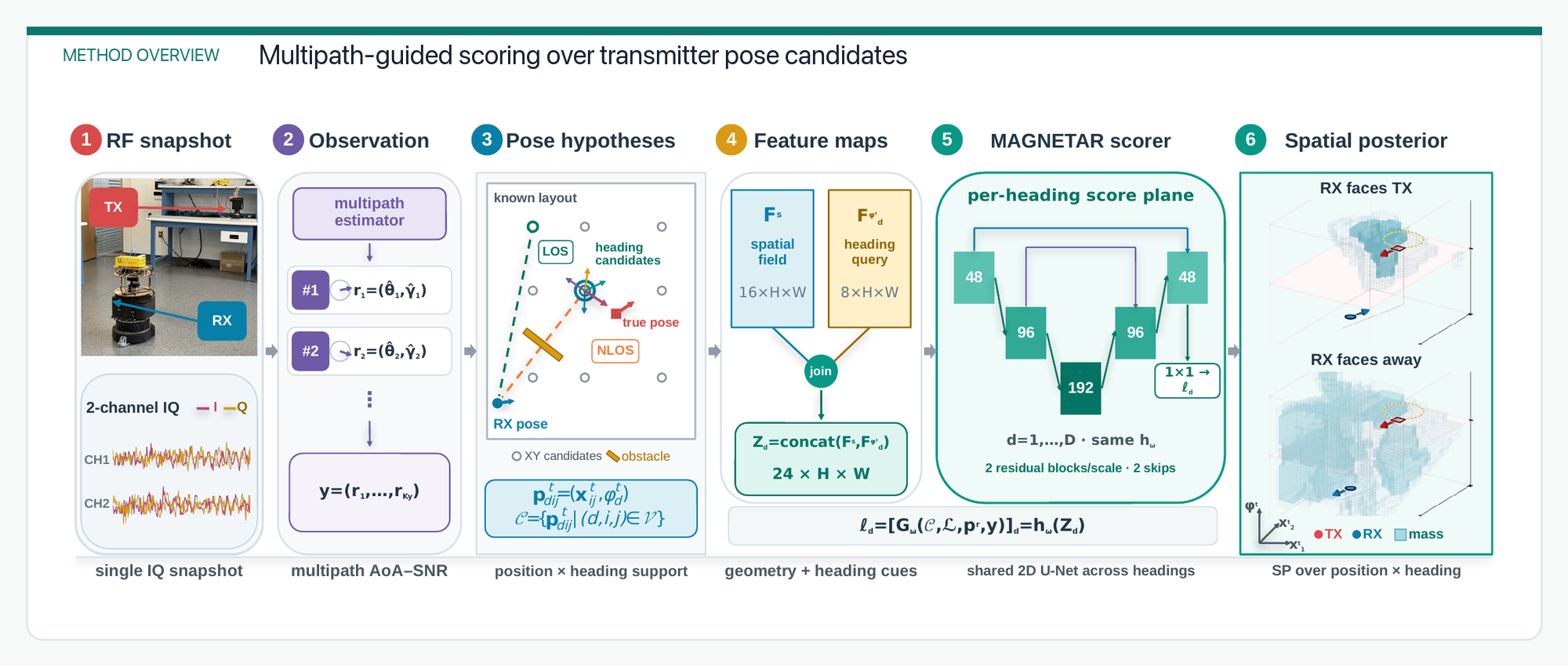
I lead MAGNETAR from probabilistic formulation and neural architecture design through real-to-sim calibration, MobiFR3 integration, experiment design, and evaluation. The method estimates a joint posterior over a transmitter’s planar position and heading from one asynchronous RF multipath snapshot, rather than forcing an ambiguous observation into a single pose estimate.
The three-minute overview shows why position and heading must be inferred together, how MAGNETAR scores pose hypotheses, and how it is evaluated with robotic measurements.
Method
- Represents each observation by angle-of-arrival and signal-to-noise-ratio estimates, together with the known room layout and receiver pose.
- Uses a heading-conditioned shared 2D U-Net to score and jointly normalize a discretized position-heading grid.
- Trains primarily in real-to-sim-calibrated 10-GHz simulation, with measured antenna patterns and RF-chain/noise effects, then augments training with 1,800 measured records.
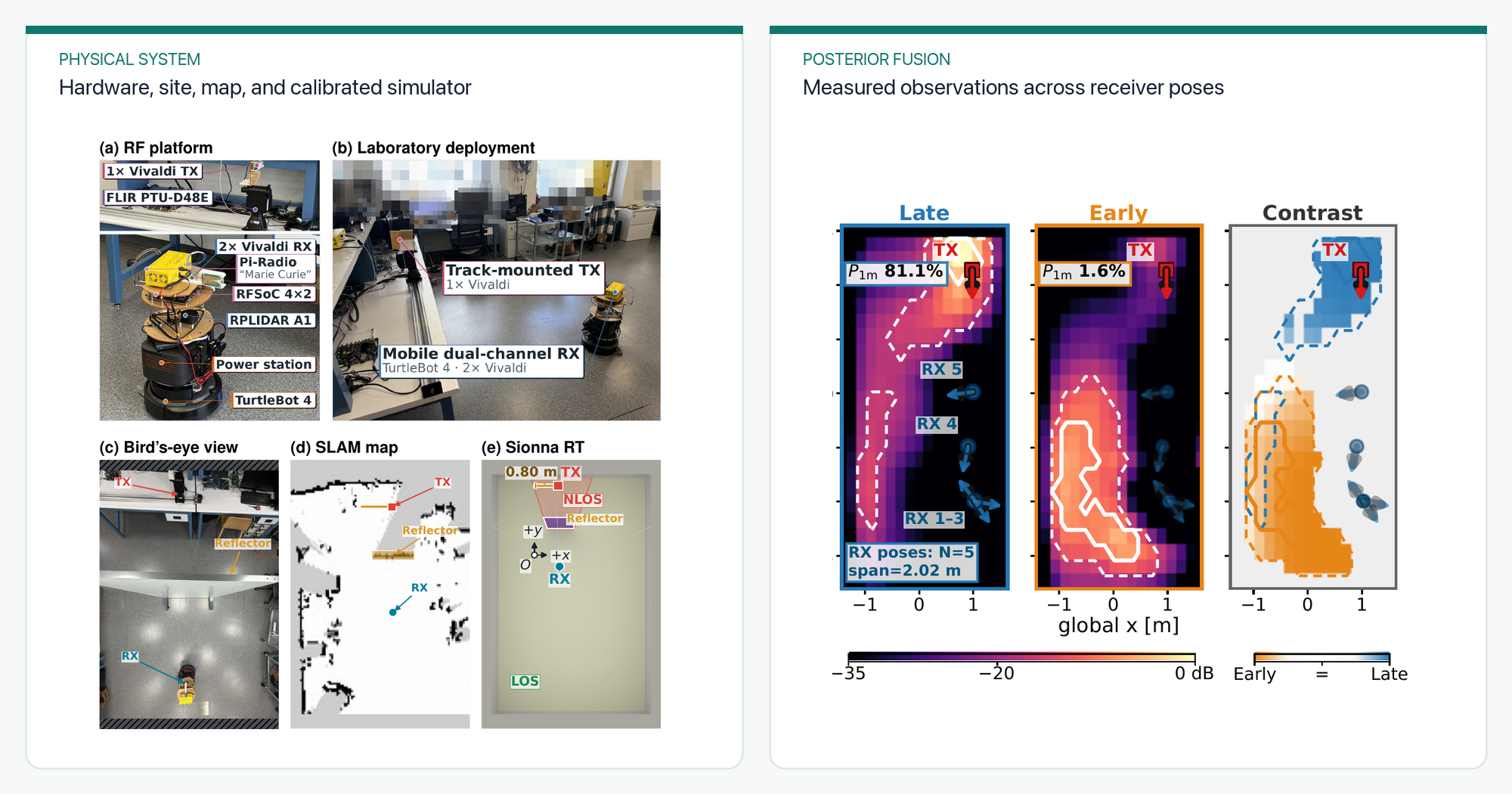
- Fuses joint posteriors across observations so that evidence with incompatible heading hypotheses does not reinforce the wrong position.
Physical evaluation
The experimental study uses MobiFR3, the robotic RF system that I lead. On 24,000 held-out measurements, the heading-conditioned scorer achieved the lowest real-data negative log-likelihood and the highest joint hit rate among the tested models. Student collaborators whom I mentor contributed to RF operation and data acquisition; I led the algorithm, calibration, RF-robot integration, experimental design, and evaluation.
Paper: MAGNETAR: Multipath-Guided Spatial Posteriors for Transmitter Pose Inference in the Upper Mid-Band — first and corresponding author; IEEE ICRA 2027, under review.