LOCUS-DT: Localization via Observation-Conditioned Uncertainty Scoring with Digital Twins

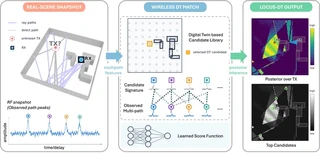 LOCUS-DT connects observed multipath, a wireless-digital-twin candidate library, learned compatibility scoring, and posterior localization.
LOCUS-DT turns a wireless digital twin into a probabilistic inference engine: candidate-specific multipath signatures are scored against the observation and normalized into a spatial posterior, retaining multiple plausible locations when the evidence is incomplete.
The continuing journal study, Site-Agnostic Posterior Inference for Indoor Localization with Ray-Tracing Wireless Digital Twins, develops the framework around site generalization and explicit digital-twin mismatch; a revision is in preparation for resubmission to IEEE Transactions on Wireless Communications.

Haozhe Lei (Graduate Student Member, IEEE) is a Ph.D. candidate in Electrical and Computer Engineering at New York University, advised by Professor Sundeep Rangan in NYU WIRELESS. He expects to graduate in May 2027. He received the B.E. degree in electrical engineering and automation from China Agricultural University in 2019 and the M.S. degree in computer engineering from NYU in 2022.
His research focuses on RF sensing and probabilistic spatial intelligence for autonomous systems. He develops likelihood-based and neural posterior methods, measurement-aligned wireless digital twins, and Bayesian fusion algorithms that turn sparse RF observations into calibrated beliefs over location and pose. His current work includes MAGNETAR and MAPLE-RF, MC-CLE and LOCUS-DT, the MobiFR3 robotic RF testbed, and MCMB-HDT for closed-loop multi-band adaptation. He leads algorithm, calibration, and experimental-system development while mentoring students in RF localization, robotic measurements, and multimodal spatial reasoning. He received the 2023 Ernst Weber Fellowship from the NYU Tandon School of Engineering.