Beyond Point Estimates: Likelihood-Based Full-Posterior Wireless Localization

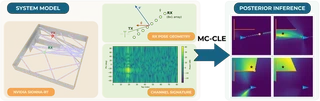 MC-CLE maps the ray-traced scene, receiver pose geometry, and channel signature to a full spatial posterior.
MC-CLE scores candidate transmitter states rather than regressing directly to one coordinate. The resulting posterior retains spatial ambiguity created by blockage, antenna directivity, and multipath, and provides a probabilistic interface for multi-view fusion and downstream decisions.
The continuing journal study, Learning a Measurement-to-Posterior Map for Wireless Localization, is under review at IEEE Transactions on Vehicular Technology.

Haozhe Lei (Graduate Student Member, IEEE) is a Ph.D. candidate in Electrical and Computer Engineering at New York University, advised by Professor Sundeep Rangan in NYU WIRELESS. He expects to graduate in May 2027. He received the B.E. degree in electrical engineering and automation from China Agricultural University in 2019 and the M.S. degree in computer engineering from NYU in 2022.
His research focuses on RF sensing and probabilistic spatial intelligence for autonomous systems. He develops likelihood-based and neural posterior methods, measurement-aligned wireless digital twins, and Bayesian fusion algorithms that turn sparse RF observations into calibrated beliefs over location and pose. His current work includes MAGNETAR and MAPLE-RF, MC-CLE and LOCUS-DT, the MobiFR3 robotic RF testbed, and MCMB-HDT for closed-loop multi-band adaptation. He leads algorithm, calibration, and experimental-system development while mentoring students in RF localization, robotic measurements, and multimodal spatial reasoning. He received the 2023 Ernst Weber Fellowship from the NYU Tandon School of Engineering.