Wireless Indoor Navigation & SLAM
Jan 1, 2025
·
1 min read
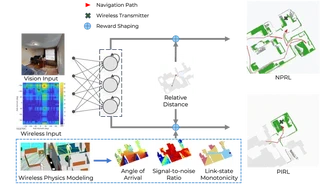
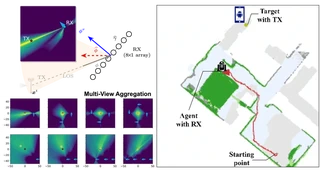
We develop zero-shot navigation and sensing pipelines that combine physics-informed reinforcement learning, digital twins, and full-posterior RF inference for robust indoor autonomy.
Related papers
- Zero-Shot Wireless Indoor Navigation through Physics-Informed Reinforcement Learning (ICRA 2024)
- Digital Twin-Enhanced Wireless Indoor Navigation: Achieving Efficient Environment Sensing with Zero-Shot Reinforcement Learning (IEEE OJ-COMS 2025)
- Reinforcement Learning with Physics-Informed Symbolic Program Priors for Zero-Shot Wireless Indoor Navigation (RLC 2025)
- Beyond Point Estimates: Likelihood-Based Full-Posterior Wireless Localization (arXiv 2025)

Authors
Ph.D. Candidate in Electrical and Computer Engineering
Haozhe Lei (Graduate Student Member, IEEE) received the B.E. degree in electrical engineering and automation from China Agricultural University, Beijing, China, in 2019, and the M.S. degree in computer engineering from New York University (NYU), NY, USA, in 2022. He is currently pursuing the Ph.D. degree in electrical engineering with NYU Wireless, under the supervision of Professor Sundeep Rangan. His research interests include RF sensing, Wireless Robotics, integrated sensing and communication (ISAC), and reinforcement learning. His recent work focuses on likelihood-based RF localization and full-posterior inference for 6G decision making, as well as multi-band antenna/receiver coordination under mobility. He also develops wireless robotics systems for indoor navigation, including a mobile-robot-based FR3 platform for closed-loop localization and navigation experiments. He was a recipient of the 2023 Ernst Weber Fellowship from the NYU Tandon School of Engineering.