RF Belief Inference & LOCUS-DT
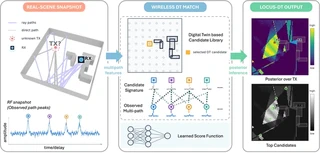
I develop posterior RF localization methods that preserve competing transmitter-location hypotheses instead of collapsing wireless observations into a single point estimate. This line includes MC-CLE for candidate-likelihood posterior inference and LOCUS-DT, which uses ray-tracing wireless digital twins as candidate-indexed multipath libraries for site-agnostic, layout-aware uncertainty scoring.
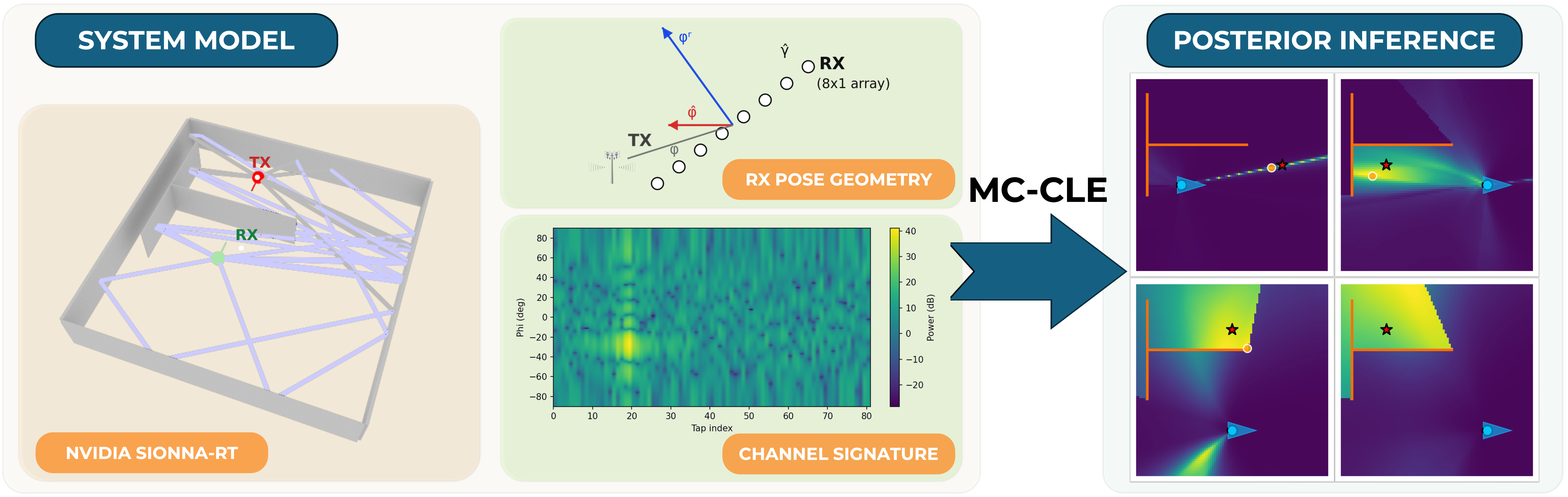
MC-CLE uses the ray-tracing scene, receiver pose geometry, and channel signature to score candidate transmitter locations and produce a posterior belief map.
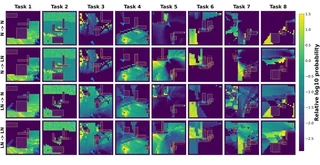
The LOCUS-DT heatmaps show how digital-twin likelihoods preserve multipath-driven spatial hypotheses, while simpler Gaussian baselines tend to smooth out the uncertainty structure.
Related papers
- Beyond Point Estimates: Likelihood-Based Full-Posterior Wireless Localization (Asilomar 2026)
- Likelihood-Based Wireless Localization with Last-Bounce Spatial Features (Asilomar 2026)
- Learning a Measurement-to-Posterior Map for Wireless Localization (IEEE TSP, under review)
- LOCUS-DT: Localization via Observation-Conditioned Uncertainty Scoring with Digital Twins (IEEE GLOBECOM 2026)
- Site-Agnostic Posterior Inference for Indoor Localization with Ray-Tracing Wireless Digital Twins (IEEE TWC, under review)

Haozhe Lei (Graduate Student Member, IEEE) is a Ph.D. candidate in Electrical and Computer Engineering at New York University, advised by Professor Sundeep Rangan in NYU WIRELESS. He received the B.E. degree in electrical engineering and automation from China Agricultural University in 2019 and the M.S. degree in computer engineering from NYU in 2022. His research develops uncertainty-aware wireless intelligence for embodied autonomy and adaptive 6G systems, combining algorithms, digital twins, and physical testbeds to transform sparse RF and multimodal observations into calibrated spatial beliefs and closed-loop decisions.
His current work includes MC-CLE and LOCUS-DT for posterior RF localization, PIRL and wireless digital-twin priors for zero-shot robot navigation, MCMB-HDT for closed-loop multi-band handset adaptation, and object-centric graph memory for multimodal spatial reasoning. He also builds FR3/mmWave RFSoC/Pi-Radio channel-sounding systems with TurtleBot4 and Jackal UGV platforms. He received the 2023 Ernst Weber Fellowship from the NYU Tandon School of Engineering.