Multi-Band UE Coordination Under Mobility
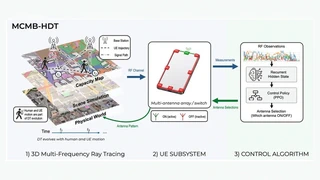
I lead MCMB-HDT (Multi-Cell Multi-Band Handset Digital Twin), including the research direction, system formulation, digital-twin design, and learning methods, while mentoring a Ph.D. student on implementation and evaluation. The framework couples urban geometry, base-station topology, FR1/FR3 ray tracing, handset antenna patterns, pedestrian motion, device pose, and measurement-limited feedback.
On top of this twin, a Transformer predicts per-array rates from sparse asynchronous histories, reducing average per-array rate MSE by 28% in our study. A recurrent PPO policy then makes retain-or-explore array decisions and outperforms the evaluated greedy and bandit baselines while trading link quality against measurement overhead.
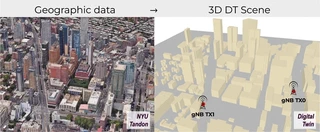
This figure shows how geographic data are converted into a 3D digital-twin scene for multi-band ray-tracing simulation.
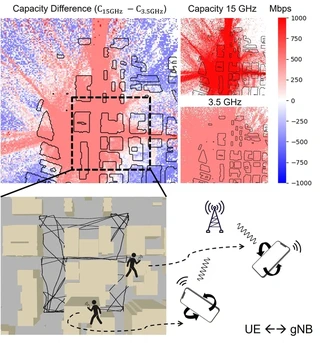
The capacity maps illustrate why the best band and antenna choice changes with location, handset pose, and pedestrian mobility.
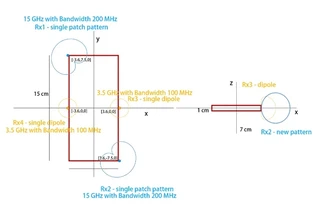
The UE layout defines the active antenna elements and frequency bands used by the prediction and activation policies.
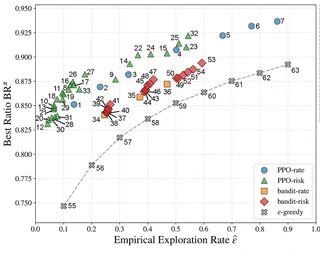
The policy result summarizes the tradeoff between exploration risk and achievable rate when the handset activates only a subset of arrays and bands.
Related papers
- Transformer-Based Rate Prediction for Multi-Band Cellular Handsets (IEEE ICC Workshops 2026)
- MCMB-HDT: A Multi-Cell Multi-Band Handset Digital Twin for Learning-Based Closed-Loop Array Activation (IEEE JSAC, under review)