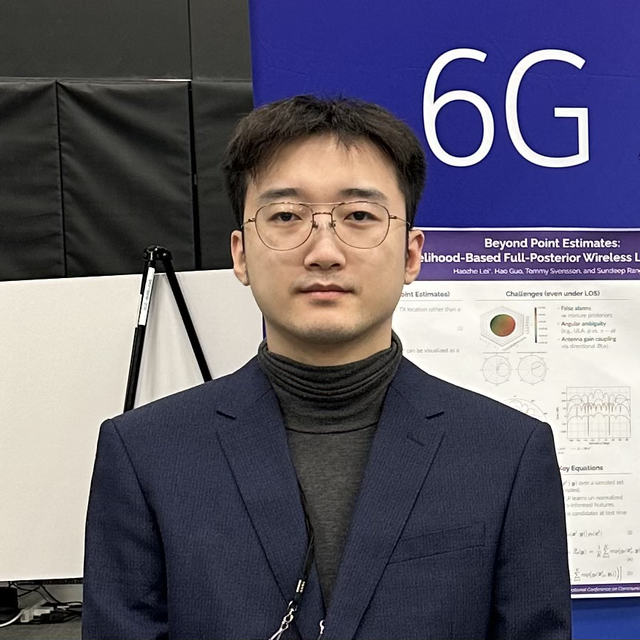
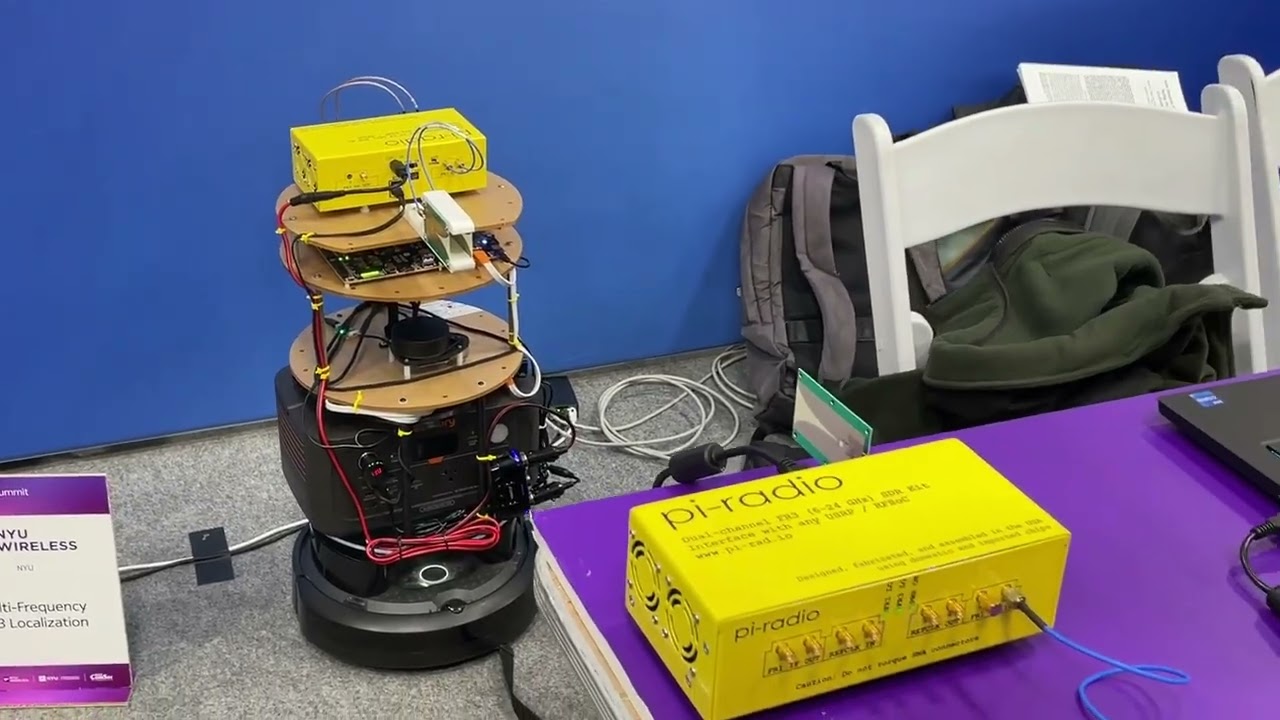
Brooklyn 6G Summit 2025
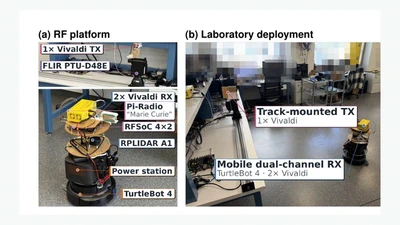
MobiFR3 in a live research demonstration
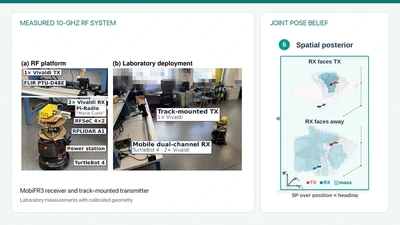
I demonstrated our 10-GHz robotic RF platform and discussed how probabilistic localization can support indoor positioning when visual information is incomplete.
I am an ECE researcher connecting RF sensing and probabilistic spatial inference with robotics and autonomous systems. My central question is how a robot or wireless device can use sparse, ambiguous RF observations to support localization and task-driven sensing when maps and propagation models are imperfect.
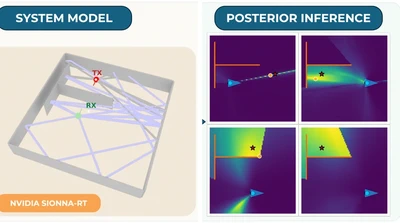
I begin with wireless propagation and physical sensing, use real-to-sim calibration to align RF simulations with measurements, and develop likelihood-based and learned posterior models that preserve uncertainty over position and pose. My work spans RF localization, physics-informed navigation, and closed-loop wireless adaptation. I am developing task-driven RF sensing for spatial decisions in robotics and autonomous systems.
Ph.D. in Electrical and Computer Engineering
2022
Expected May 2027
New York University
M.S. in Computer Engineering
2020
2022
New York University
B.E. in Electrical Engineering and Automation
2015
2019
China Agricultural University
Across five core projects—MC-CLE, LOCUS-DT, MAGNETAR, MAPLE-RF, and MobiFR3—I combine measurement-conditioned inference, wireless digital twins, and robotic experimentation to turn ambiguous RF evidence into spatial beliefs for localization, sensing, and action.

Five core projects span posterior inference, wireless digital twins, joint pose and partial-map localization, and robotic RF experimentation; two secondary lines capture earlier and complementary work.
Core project
Candidate-wise neural likelihood estimation from sparse AoA and SNR measurements, preserving directional and multimodal uncertainty beyond point estimates.
Core project
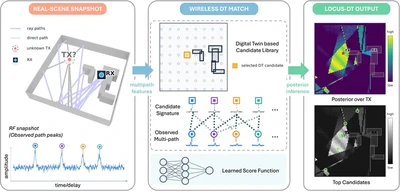
Observation-conditioned scoring of measured multipath against ray-traced location hypotheses for site-agnostic spatial posterior inference.
Core project
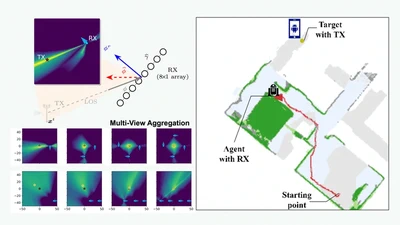
Multipath-guided joint posteriors over transmitter position and heading, calibrated from simulation and evaluated on a 10-GHz robotic RF testbed.
Core project
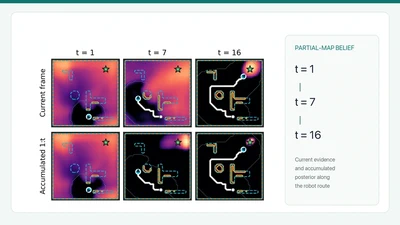
Efficient neural posterior inference for RF source localization while a robot has explored only part of its environment.
Core project
A 10-GHz robotic RF testbed connecting channel sounding, mobile sensing, localization, and SLAM-based navigation experiments.
Secondary project
Ray-tracing digital-twin priors and physics-informed reinforcement learning for zero-shot indoor navigation.
Secondary project
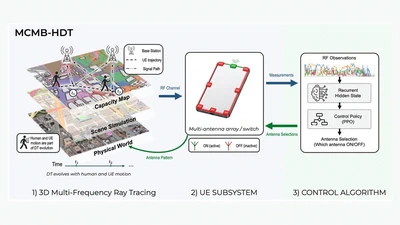
UE-centric multi-cell multi-band handset digital twins for closed-loop array, band, and rate prediction under mobility.
Representative manuscripts and peer-reviewed work tracing the progression from wireless posterior inference to robot-facing spatial belief and action.
Current manuscripts
Selected peer-reviewed work
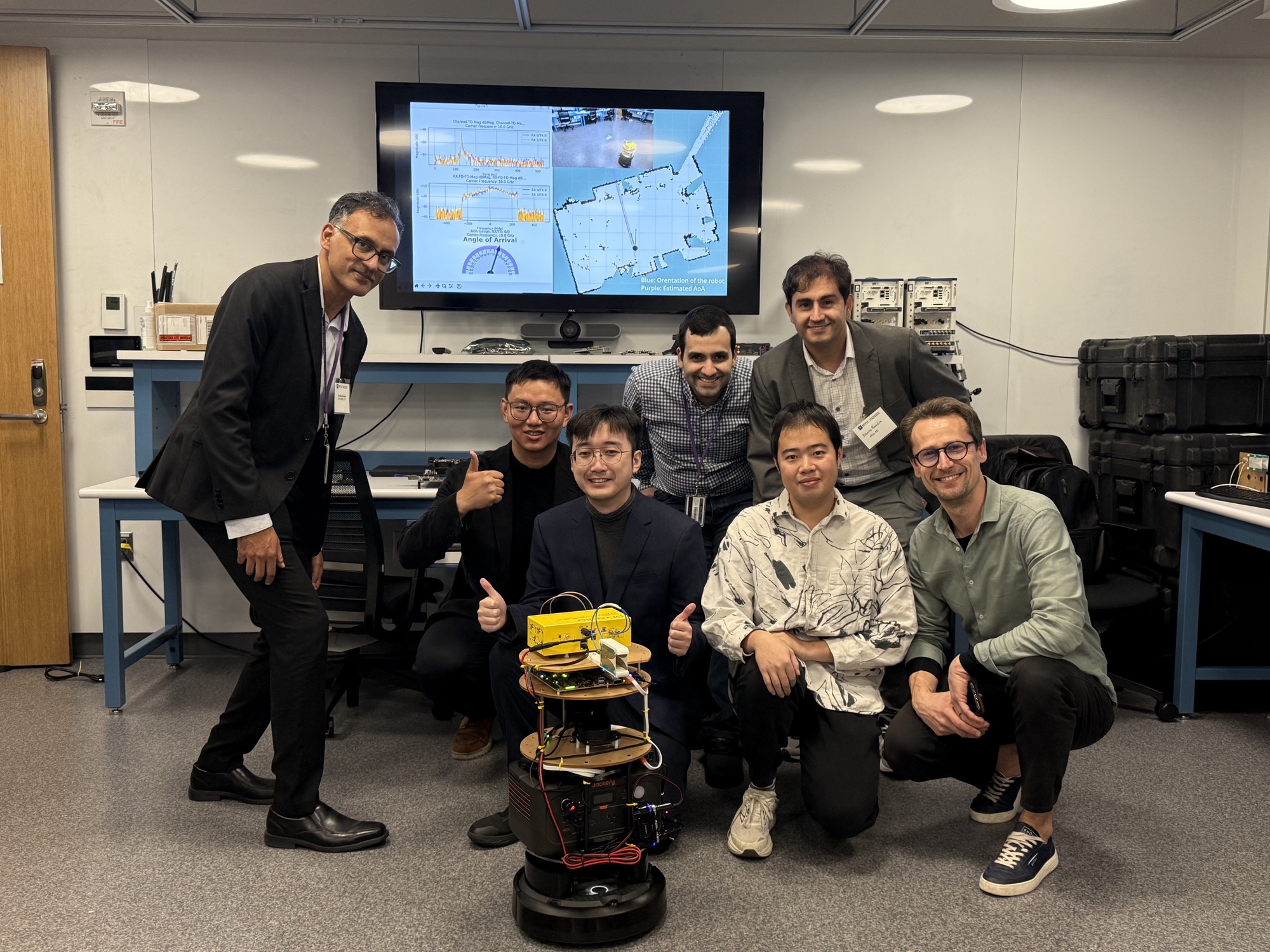
NYU WIRELESS
At NYU WIRELESS, I develop wireless models and probabilistic inference, align them with measured RF, and validate the resulting spatial beliefs on the MobiFR3 robotic platform.
Center overviewEducation
2023 Ernst Weber Fellowship · NYU Tandon
Research conversations and collaboration